Giveaway you can measure today
Hand-portioning overfills to stay safe. Every gram over target is product given away — plus failed checkweighs and rework on top. Your checkweigher data already knows the number; most plants are surprised by it.
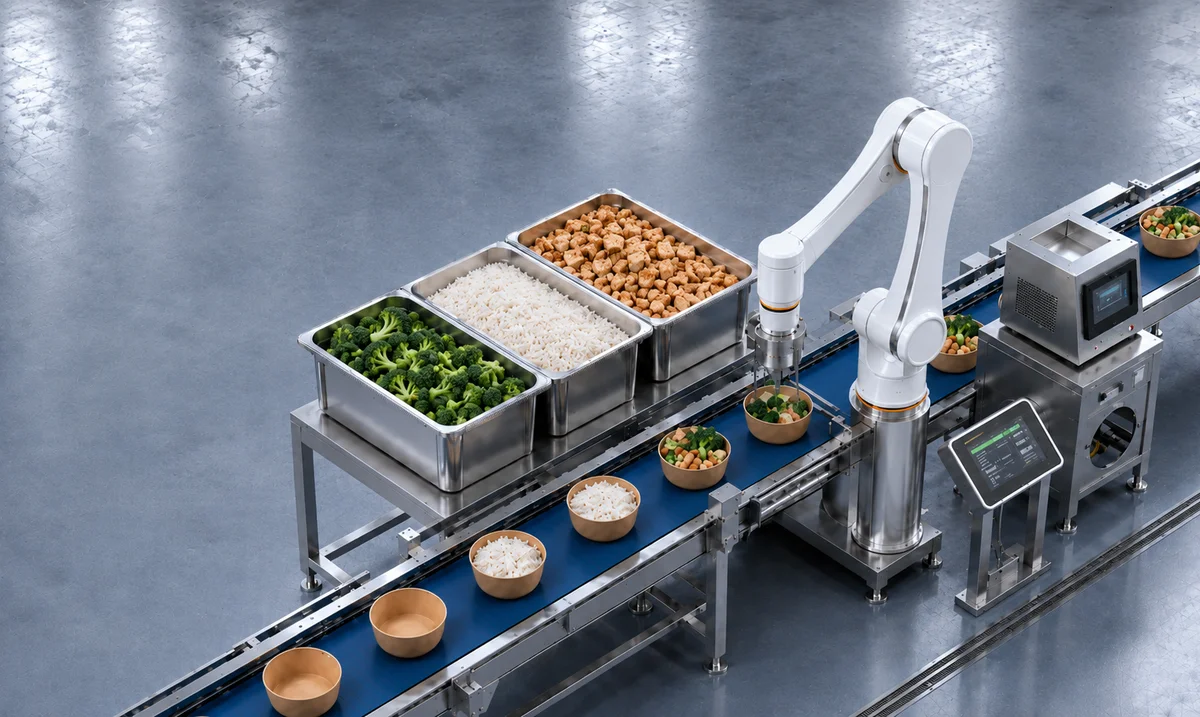
Merista is building operated portioning robots for chilled prepared-meal lines — robots that portion every ingredient to target weight on the line you already run. We are selecting design-partner factories, and we start with a number, not a commitment: what giveaway costs you today, from your own checkweigher data.
On a high-mix line — 20+ SKUs, frequent changeovers, formats a fixed machine can't hold — this work is still done by hand. Three costs come with it, and your own data already knows the size of each.
Hand-portioning overfills to stay safe. Every gram over target is product given away — plus failed checkweighs and rework on top. Your checkweigher data already knows the number; most plants are surprised by it.
Repetitive portioning seats are manageable — until you add a shift, win a contract, or widen the range. Then the same 3–5 seats per shift become the bottleneck: hard to fill, harder to keep filled, and multiplied by every shift you add.
Portion weights drift with fatigue and turnover, and QA is a sample, not a record. Necessary work — and a poor use of human attention.
You can put a number on all three today — the giveaway from your own checkweigher exports, the seats from your own payroll.
The structure is the offer. Here is where the money comes from, in the order it matters — and where the risk sits.
Portioning to target weight, every tray, recovers the grams-over-target you can quantify from your own checkweigher data — before a single robot runs. On expensive ingredients this can rival the labor saving itself.
The fee is set as a share of the fully-loaded cost of the two shifts each robot replaces — about 25% below it, verifiable against your own payroll. The fee floats with your labor cost, not a list price.
Fewer failed checkweighs, less rework, and every portion logged.
Merista owns the hardware — nothing lands on your balance sheet, nothing to depreciate.
Monitoring, recovery, and maintenance are ours; you add no maintenance headcount. Your team runs the line; we keep the robot healthy.
We prove the payback on a single line before anything scales; expansion only on your say-so.
"Operated by Merista" is a division of labor, not a slogan. Here is who owns what on the floor.
No per-robot fees, payback months, or fee bands here — the exact economics are built from your numbers during the walkthrough.
The robot works in the footprint of one worker station, on the line you have — not a line you need to rebuild. It uses perception and weight sensing to guide each portion, performs the deposit with a food-safe arm, and runs an inline QA check before the tray moves on. Every portion and check is logged.
Loaded and refilled by your team, on your schedule.
Perception and weight sensing guide each portion to target.
Placed onto the tray already moving through your process.
Each result checked and logged before it moves on.
Monitored remotely; we keep the robot healthy.
Hygienic design, washdown-aware architecture, cleaning validated with your QA, and safety and CE conformity are part of the robot from the start. We state what is certified as certified and what is planned as planned.
The robot is designed down, not up: the footprint of one worker station (0.8 × 0.8 × 2.0 m), no mobility, one task family at a time, standard gastronorm (GN 1/1) pans. Every subsystem we deleted is downtime you never see and cost you never pay. We don't automate everything on the line, and we don't pretend to.
On the right line, a single-purpose machine is a fine answer — and we say so below. Our case is the high-mix line: the few things a fixed machine physically can't do, plus the one lever it destroys — your freedom to grow and change what you make.
A new recipe, ingredient, or pack format is a software push, not a re-tool. A fixed machine forces you to design new products around the tooling you already own. We don't put a ceiling on what you're allowed to sell.
Portioning today; topping, inspection, and rework-adjacent handling as capability is added task by task — including the fragile and individual items a fixed machine can never take. The delivery mechanism — software pushed to deployed robots — is real today; the breadth is the trajectory.
100% weight-check and a factual record for every portion — traceability a hand line can't deliver and a fixed machine doesn't either.
Every deployment hardens recovery, QA, and task coverage for every robot in the field. The system you rent in year two is more capable than the one installed in year one.
On a low-mix, stable, single-format line, buy the machine — we don't compete there, and we'll tell you so in the walkthrough. We win on high-mix lines that are trying to grow.
We built and operated autonomous food production across Europe and the U.S. in live, customer-facing service — years of uptime, recovery, and QA discipline, not a demo. That operating discipline — monitoring, remote recovery, maintenance — is exactly what keeps a robot on your line from day one.
Operating record achieved at REMY Robotics by the Merista founding team
We take your checkweigher data and your fully-loaded seat cost and give you back two numbers: what giveaway is costing you today, and what a robot on that seat would save — in your units: per meal, per line, per year. Your data, your numbers, before you commit to anything.